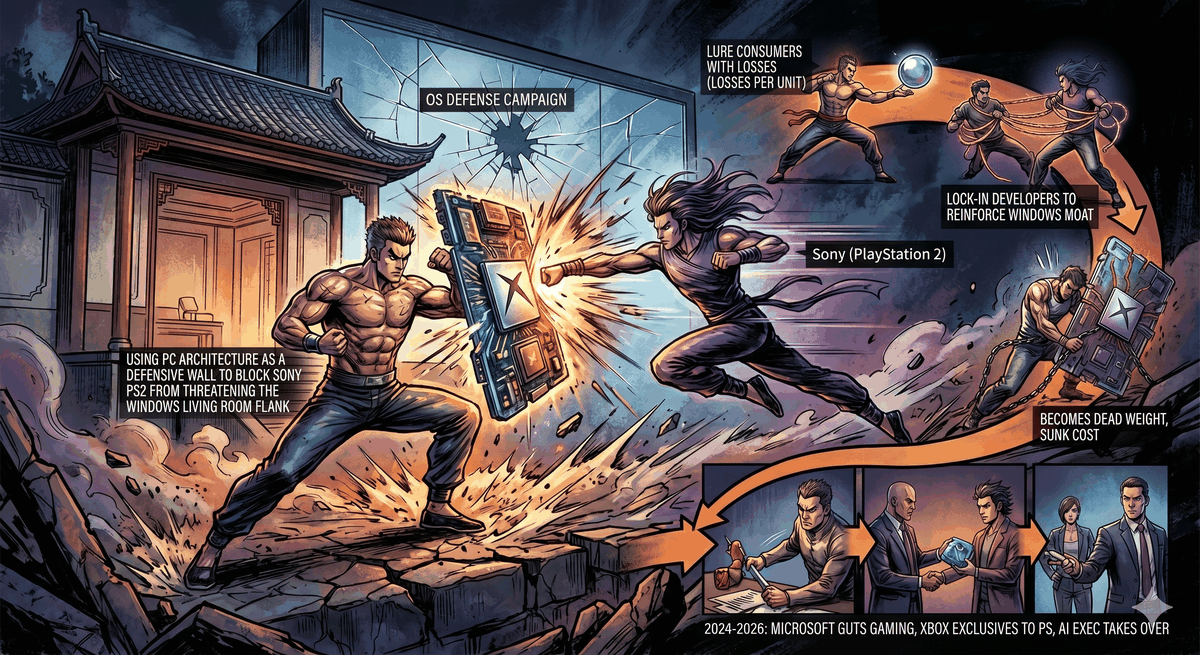
第三章 微軟的恐懼與 Xbox 的誕生
Chapter 3: Microsoft's Fear and the Birth of Xbox
In January 2024, Microsoft announced the layoff of 1,900 people from its gaming division. Three months earlier, it had just spent $69 billion to complete the largest acquisition in the history of human commerce—Activision Blizzard. In the spring of the same year, several Xbox exclusive games quietly appeared on the PlayStation 5 store. By autumn, Phil Spencer—the last spokesperson of the Xbox brand trusted by gamers—handed over the reins.
A young game developer stared at the news, feeling something was off. You spend the most money in the world to buy the largest game publisher in the world, and then you send its games to your competitor's console? Your entire hardware team is laid off, your studios close one by one, and your exclusivity strategy exists in name only—is this a pivot, or a suicide?
Seamus Blackley—the co-creator of the original Xbox in 2001—offered a phrase on social media: palliative care.
A console, from birth to palliative care, walked for twenty-three years.
But if you go back to the day it was born, you will find—its fate was decided the moment it was created. Because Xbox was never born to win the console war. It was born so Microsoft wouldn't lose another war.
I. Motive for the Crime
In March 1999, Sony held a press conference in Tokyo. Ken Kutaragi stepped onto the stage and showed the world the core of the PlayStation 2: a chip called the Emotion Engine.
Ken Kutaragi was not a man of low profile. He didn't call the PS2 a "game console." He called it "the home computer of the twenty-first century." His slides contained charts, computing power comparisons, and a side-by-side floating-point performance comparison between the PS2 and a workstation CPU. His subtext was completely unsubtle: the computing power of this console had already touched the territory of low-end PCs. He hinted that the PS2 would one day be able to browse the internet, act as a DVD player, and even run operating systems.
Two years later, Sony actually did release a Linux kit specifically for the PS2, complete with a keyboard, mouse, and hard drive. It didn't run very well. But that wasn't important.
What was important was the panic that press conference triggered in Redmond.
Gates' concern touched the exact same nerve as his fear five years earlier when DOS games couldn't run: the entry point. The previous entry point was the desktop PC—young people played games on it, and when they grew up, they continued using Windows in the office. This time, the entry point was the living room. If the box under every family's TV was a PlayStation instead of a Windows PC; if Sony turned the PS2 into a home terminal that could browse the internet, process documents, and send and receive emails—the moat of Windows in the consumer market would start leaking from the living room side.
Gates convened a high-level meeting. In the version that later leaked out, he asked a very Gates-esque question: "What do we have that can stop this?"
The answer was nothing. Microsoft had no console, no home hardware, and no game development studios. It had absolutely no presence in the consumer's living room.
So he made a decision—build one.
II. Forging the Weapon
Before this matter even surfaced on Gates' desk, four people inside Microsoft were already secretly building a prototype. Seamus Blackley was the most technically proficient among them—he had previously developed a game called Trespasser at Looking Glass Studios. When that game's physics engine ran on consumer-grade PCs in 1998, it was so severely ahead of its time regarding hardware capabilities that it resulted in a commercial disaster. Blackley learned one thing from that experience: The computing power a game needs will always be more than what the current consumer hardware can provide.
The prototype proposal he and his colleagues came up with had an extremely straightforward name: DirectX Box.
The name gave everything away. This was not a game console—this was a machine that ripped DirectX out of the PC and stuffed it under the television. Its CPU was from Intel, its GPU was from NVIDIA, its core operating system was a stripped-down version of Windows 2000, and its development tools were simply Visual Studio plus the DirectX SDK. Microsoft didn't even plan to design its own chips, nor did it plan to invent a new API. What it set out to do was precise to the point of cruelty: Take the exact toolset PC game developers already knew, and move it intact into the living room.
Only those who have read Chapter 2 can truly appreciate the brilliance of this strategy.
Microsoft had spent five years using DirectX to lock the entire PC game development ecosystem onto Windows. By 1999, the engine of every mainstream PC game studio on the market was written in Direct3D, their toolchains were Windows-based, and their engineers had grown up using Visual C++. Writing games for Windows was as natural as breathing to them.
The genius of the Xbox was this: It wasn't asking these developers to learn anything new. It was just copying the building they already lived in and placing it in the living room.
For developers, making games for the Xbox came at almost zero cost—the same API, the same IDE, the same shader language. Change a few lines of code, and your PC game runs on the Xbox. This "almost free cross-platform" capability was something neither Sony nor Nintendo could offer. The PS2's Emotion Engine architecture was exceptionally bizarre, and its development difficulty was notorious at the time; Nintendo's GameCube was an entirely closed-off world.
But this design also exposed the Xbox's most fatal structural problem—its hardware cost was calculated based on the price of PC components.
When Sony and Nintendo built consoles, they used highly customized chips, meaning the marginal cost after mass production was extremely low. Microsoft used Intel's Pentium III and NVIDIA's custom GPU—both were publicly traded companies, both had their own gross margin requirements, and neither could possibly slash their profits for Microsoft's console dream. The result: For every Xbox sold, Microsoft lost over $100. Throughout the lifespan of the first-generation Xbox, Microsoft's hardware losses conservatively exceeded $4 billion.
That number was astronomical in the gaming industry at the time. But to Microsoft, $4 billion was not a gaming investment—it was an insurance premium. It insured the living room flank of Windows. As long as the PS2 failed to become the standard for home computers, the consumer entry point for Windows was safe. As for whether the Xbox itself made money, it didn't matter.
Gates approved this insurance policy.
III. Defense
On November 15, 2001, the Xbox launched in North America.
Gates himself attended the midnight launch event—a man worth tens of billions of dollars, standing at the door of Toys "R" Us in New York's Times Square, personally handing the first Xbox to consumers waiting in line. The image was broadcast by media worldwide. But most reporters on the scene didn't realize one thing: what they were witnessing was not a software company "entering the gaming industry," but the opening ceremony of an operating system defense war.
When the Xbox launched, the blockbuster title accompanying it was Halo: Combat Evolved. The studio behind it, Bungie, had originally been making it as a Mac game—Apple's Steve Jobs had even personally demonstrated an early version of Halo at Macworld in 1999. Microsoft outright bought Bungie, turning Halo from a Mac exclusive into an Xbox exclusive.
The logic of this acquisition perfectly matched the logic of the entire Xbox: It wasn't about making a good game; it was about ensuring the competitor's platform didn't have a good game. Every step Microsoft took in the console market carried the DNA of a defender—I don't need to win; I just need you to not win too much.
But the DNA of a defender also means one thing: the day the threat disappears is the day the weapon loses its reason to exist.
IV. Closing Arguments
The PS2 ultimately sold over 155 million units, making it the best-selling game console in history. Ken Kutaragi's "home computer" dream never materialized—the PS2's Linux kit sold fewer than 100,000 units, and the vast majority of buyers only used the console to play games and watch DVDs.
Microsoft's fear, in retrospect, was overestimated. The PS2 never truly threatened Windows. What truly replaced the home PC was not the living room console, but the smartphone in everyone's pocket a decade later—but that is another story.
However, the Xbox had already been built. The $4 billion had already been spent. An entire gaming division had already been established.
What do you do with a weapon forged for defense?
Microsoft chose a seemingly logical path: since they had already invested so much money, they might as well do it seriously. The Xbox 360 launched in 2005 and finally started turning a profit in certain quarters. The Xbox One launched in 2013, its market share crushed by the PS4, but the Game Pass subscription model showed Wall Street "recurring revenue." By 2023, Microsoft spent $69 billion to buy Activision Blizzard—the largest acquisition in the history of human gaming.
On the surface, this path looked like a success story that kept growing bigger.
But deep down, the DNA of the Xbox had never changed since day one. It was a wall, not a city. The function of a wall is to keep invaders out; the function of a city is to allow the people inside to prosper. Microsoft never managed the Xbox as a city that needed its residents (players) to flourish—every major decision it made started from the perspective of "what the Windows empire needs."
So when Satya Nadella made a judgment in 2023—that AI was the next battlefield needing insurance, and the living room was long obsolete—the fate of the Xbox was flipped in that exact moment. Activision games bought for $69 billion were released on PlayStation. Exclusive games were opened up one by one. The hardware team suffered layoffs. Studios were closed.
This wasn't suicide. This was a wall being torn down, its bricks moved to build another wall.
The new wall Nadella was building was called AI infrastructure. The AI capital expenditure Microsoft announced in 2024 exceeded $80 billion. Where did this money come from? Part of the answer: it was squeezed out of a gaming division that no longer required loss-making subsidies.
Here, the pattern identified in Chapter 2 reappears—only this time, its direction is reversed.
DirectX's pattern was offensive: Use convenience to attract developers, lock in the ecosystem, and finally lock in the consumers. The Xbox's pattern was defensive: Use losses to block the flank, use time to drain the opponent's ambition, and then when the threat subsides, dismantle the fortifications and reallocate resources to the next battlefield.
Both patterns share the exact same underlying assumption: gaming is not the end goal; gaming is the means. Players are not customers; players are bargaining chips.
When a company treats gaming as a means rather than an end, it will never sacrifice its own strategic interests for the interests of the players. This principle will reach its final settlement in Chapter 10—how Microsoft ultimately disposed of the debris of the Xbox.
V. The Loot is Still Being Divided
Back to the young developer staring at the news in 2024.
He felt Microsoft's actions were irrational, because he understood the Xbox as a game console. A game console company spending $69 billion to buy a game studio, only to give those games to its rival—of course that's irrational.
But if he understood the Xbox as a wall, everything would make sense. When a wall is no longer needed, you tear it down and move the bricks to a useful place. As for the people living behind the wall—the players who bought an Xbox, subscribed to Game Pass, and trusted the "exclusive" promises—their investments were never on Microsoft's balance sheet.
This bill has not yet been settled. When Microsoft moved the Xbox's bricks to build AI infrastructure, it simultaneously tore down something else—Chapter 8 will explain how important this is—which is the console as a long-term, stable source of orders for advanced process chips. The SoCs for both the PS5 and Xbox Series X were produced by TSMC on a 7nm node, with contracts lasting seven to ten years. These kinds of orders are one of the ballast stones that give TSMC the courage to invest in next-generation nodes. If the console market shrinks, this ballast stone will loosen.
But that is for later.
What we need to talk about now is the GPU inside the Xbox chassis. It was made by NVIDIA—a custom chip based on the GeForce 3 architecture, codenamed NV2A. By 2001, NVIDIA was already the overlord of the PC graphics card market.
But five years earlier—in 1996—NVIDIA nearly died over a contract.
The client for that contract was a Japanese company. It, too, was fighting a console war it was destined to lose, with the money in its pockets dwindling by the day. According to the logic of all business textbooks, it should have saved every last cent for itself.
It didn't. It paid its final $5 million to a young man who had made a fatal mistake.
That company was Sega. That young man was Jensen Huang.